Sunday, March 19, 2017

Broken Streaks

Photo: NASCAR.com
It's hard to believe either of these guys went over three seasons without a single victory.

Ryan Newman stole the Monster Energy NASCAR Cup Series race at Phoenix International Raceway this afternoon, inheriting the lead after choosing to stay out of the pits after a late-race caution and holding off Kyle Larson for the win. It was Newman's first victory in 127 races, his last win coming at Indianapolis in 2013.

Richard Childress, Newman's team owner, also won his first Cup race in quite a while. The last time Richard Childress Racing won a Cup race was, ironically, at Phoenix, also in 2013, with Kevin Harvick behind the wheel.

While Newman and Childress were the feel-good stories of the day, one has to feel for Larson. The fourth-year driver recorded his third consecutive second-place finish and fourth in the last five races.

Thursday, March 9, 2017

Something is Rotten in the State of Denmark

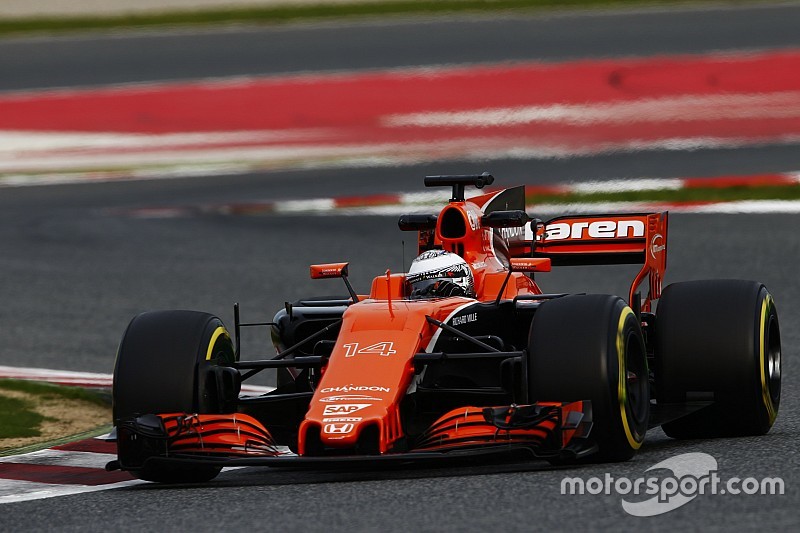
Alonso: Honda has no power and no reliability
Photo: Motorsport.com
All Hamlet references aside, something is definitely rotten in Honda's 2017 power unit.

McLaren driver Fernando Alonso insists that McLaren's preseason testing struggles can be deduced solely from the team's Honda engines, which have struggled to keep pace with those of Mercedes, Ferrari, and Renault. When asked about McLaren's current situation, Alonso replied, "I don't think we are too far back in terms of chassis side. We have only one problem: that is the power unit. There is no reliability and there is no power. We are 30 km/h down on the straight, every straight."

Since their power unit switch from Mercedes to Honda in 2015, McLaren have struggled mightily and have yet to record a single podium with their new engine partner. While the team's performance has improved somewhat since the change, McLaren still are not the team that they once were.

One has to wonder if Alonso's patience is wearing thin. The double World Champion will be 36 this summer and is in the final year of his current contract with McLaren. While a bad year may not force him out of Formula One, it may force him into joining a new team if he wants a chance to win a third World Championship.

UPDATE: Well, here's further proof the situation is rotten: McLaren's troubles have left Honda 10,500 km behind Mercedes in terms of distance logged this preseason. Of course, Mercedes supplies engines for three constructors (Mercedes, Williams, Force India) while Honda only supplies for McLaren, but it's still a staggering number that represents just how much trouble Honda has endured so far.

Sunday, March 5, 2017

Two Races in the Books

Photo: NASCAR.com
I've finally got some time to myself so I'll go ahead and put in a blog post now.

Ford is now 2-for-2 on the Monster Energy NASCAR Cup Series season, with Kurt Busch and Brad Keselowski earning victories at Daytona and Atlanta respectively. Kyle Larson could easily have won both of these races, but a lack of gas and a puzzling decision to run the high line have taken both potential race victories away from the Chip Ganassi driver.

I can also give an honest opinion of the stage format now that I've seen it at a non-plate track: it's not bad, certainly not as bad as I originally thought it might be. My only concern is that it turned the Daytona races into bigger wreckfests than they already are, but other than that, the racing isn't too different from past season. (I also wish they wouldn't throw the caution once the stage ends, but beggars can't be choosers.)

On another note, hold the phone on Atlanta's repave. It may not happen after all. Apparently the drivers like the track as is, so the project is going to be reconsidered. The track could certainly use one though...

Sunday, February 19, 2017

Opinion: Having Only Forty-Two Cars at Daytona is a Crime

Photo: Tommy Baldwin Racing Facebook
I've followed NASCAR full-time for the last ten seasons. The first time I watched the Daytona 500 (2007), sixty-one cars showed up for qualifications.

Sixty-one.

Yes, do the math. Sixty-one > forty-three. Eighteen cars went home that day.

Now, looking at other years around that time, this was still a rather large number, even for the biggest race of the year. But next week at Fontana, fifty-one cars showed up with the intention of racing on Sunday. A sizable amount (eight) still failed to qualify. On any given weekend, there were always multiple cars that would fail to qualify and end up going home before the featured event.

Ten years later, as I sit here write this blog post, forty-two cars, one fewer than would have made a full field back then, have just finished qualifying for the 2017 Daytona 500. Today, only forty cars make the field, so two drivers will unfortunately have to watch the race from their motorhomes.

Obviously, two is not nearly as many as eighteen.

There are many possible explanations for why the entry list is only two-thirds the size it was a decade ago. Yes, the economy is not great, and yes, that has caused several teams to downsize and even close entirely.

But NASCAR also has a new system in place: the charter system. Thirty-six teams are awarded charters by NASCAR at the beginning of every season. The process is too complicated for me to have any desire to explain it here, but the bottom line is this: if a team has a charter, they are guaranteed a spot in each race that season.

That leaves only four open spots for non-chartered teams to fill.

Not only that, but teams with possession of a charter also earn more money and added benefits than teams without one. At the end of the day, if a team has no charter, they are going to have a hard time surviving in the sport.

I understand NASCAR's thinking here. Chartered teams receive added benefits and thus are more likely to be able to sustain themselves for years to come. It thus becomes easier for chartered teams to stay in business.

But thinking like that, in my opinion, is counterintuitive.

The flip side of the charter system means that it becomes much harder for "open" non-chartered teams to stay in business. Without major sponsorship and the other benefits a charter itself brings to a team, it becomes virtually impossible to operate without losing an excessive amount of money. Since Daytona is the biggest race of the season, it's highly probable we'll see a few short fields of less than forty cars this season.

The start-and-parks are non-existent in the Cup Series nowadays. Virtually all of the smaller, unsponsored, part-time teams have had to merge or close their doors in the past few years. And as ESPN's Ryan McGee argued when this system was launched, "I worry that they're making the Charter Club a little too exclusive."

It appears McGee may be right, because there are only forty-two cars at the track at Daytona this February.

Frankly, that's a crime.

Tuesday, February 7, 2017

Stewart Returns to Indy...As a Sponsor

Photo: Motorsport.com
Tony Stewart may not be racing in NASCAR full-time anymore, but that doesn't mean he's done with racing. 

In fact, if you thought he was, you couldn't be more wrong. In addition to running at least 71 other races in 2017, Stewart's foundation will return to Indianapolis as a sponsor for Schmidt Peterson Motorsports in the Indy 500.

Stewart will be promoting his Team One Cure program aimed at helping develop and research cancer treatments in both animals and pets, explaining, "We learned that with the One Cure program, cancer treatment breakthroughs are happening through collaboration between scientists and doctors working with both people and pets. It perfectly fits with my foundation’s missions to help children and animals."

Stewart's history at Indianapolis as a driver is a mixed bag when it comes to IndyCar. In five starts, he failed to finish the race twice but also earned three top-ten finishes, with a best of fifth in 1997. The three-time NASCAR Cup champion also won the 1997 Indy Racing League championship, only further adding to his impressive motorsport resume.

Sunday, January 29, 2017

A Brief Opinion on NASCAR's New Format

With a new logo comes a whole new
era of racing.
Yes, this is a bit overdue, but there is a good reason for that.

I had a knee-jerk reaction when I first heard the news that NASCAR would be overhauling its race format and dividing each race into segments: I thought it was a terrible idea. That being said, I wanted to wait to write this opinion post until today because I wanted to give it a week or so to sink in.

Now, I'm not inherently opposed to the Chase, but I will admit, the traditionalist in me prefers the pre-Chase era. If NASCAR had had some form of the Chase since 1949, I would have no problem with it at all. But Jimmie Johnson's seven titles are virtually impossible to compare with Richard Petty's, since they were won under different points formats.

With these changes, it's now going to be impossible to compare a new driver's entire career to that of a driver from an earlier era. Chase Elliott will make a name for himself in NASCAR, but he'll do so with a different driving style, using different strategies, etc, than his father Bill used in his career. Not only will the Chase races and Championships look different, but every race will look different, as Cup Series veteran Regan Smith noted.

Based on what I've seen on social media, fan reaction has been mixed. Some find this change refreshing; others are traditionalists like me who are disappointed with such a major, sweeping change to all three series.

My main problem is not the format itself. My problem is that it's being used by an established series that has been around for nearly 70 years.

To borrow an example from open-wheel racing, Formula E is far different than Formula One when it comes to rules and regulations, and I have no problem with that. If NASCAR wanted to create some sort of electric or "green" racing series with Chevy Volts, Nissan Leafs and Toyota Priuses, I'd be happy with them using any format they want. It's a new series, why not try something different?

The three national NASCAR series, however, have already established themselves in tradition. I see no need to mix things up. Sure, the middle 100 laps can get boring sometimes, but to be honest, so can the second and third quarters of an NBA game.

In conclusion, I don't have a great feeling about this, but I also won't judge a book by its cover. The drivers all seem on board with this, so that's a positive sign. We'll know more after the first couple of races this season.

On a related note, my fellow Wikipedian, Justin Nguyen (or User:ZappaOMati), also gave his thoughts on the new format on his blog, which can be found here.

On an unrelated note, congrats to Jeff Gordon and his team on their Rolex 24 Hours of Daytona win today. It was well-deserved and only further cements Gordon's legacy as one of the greatest drivers of all time.

Saturday, January 28, 2017

Update: Manor Finally Closes Down

Photo: Mark Thompson/Getty Images
All of 2010's three new Formula One entries are officially dead.

Manor Racing announced yesterday that the team will almost certainly not race in 2017 after failing to find an investor, making their shutdown imminent.

To be honest, I thought this would not happen. Manor were in a very similar situation after the 2014 season and were able to make it through the administration process. ESPN F1's Kate Walker argues that Manor's demise was perhaps "inevitable" given the way prize money is structured in F1 these days. Walker does note that there is still (very) slim hope that an eleventh team will be on the grid next year, though it's very unlikely at this point.


"While the likelihood is remote, it remains possible that Manor could once again be saved at the eleventh hour. The team's entry in the F1 World Championship was held by a separate entity which has yet to enter administration or be declared insolvent. Should an interested party wish to pick up an F1 slot at a rock-bottom price, now is the time to do it."


The other big news that I was unable to write about this week (real-life work always comes first) is that Liberty Media have finally completed their F1 takeover. Furthermore, Bernie Ecclestone has stepped down from F1 entirely. One of the first things Liberty needs to do is reform the payout structure. Ferrari were the highest-earning team after 2015 despite finishing second in the championship to Mercedes. Ecclestone claimed: "We pay more money to Ferrari because they've been around a long time. Ferrari is Formula One and they deserve whatever we pay them."


Sorry Bernie, but that's not how it should work. Ferrari cannot get extra money for being Ferrari. As Autosport notes, McLaren received the fifth-highest amount of money in 2015 despite finishing ninth (of ten teams) in the championship. If that's the system in place, it's a miracle Manor survived as long as they did.